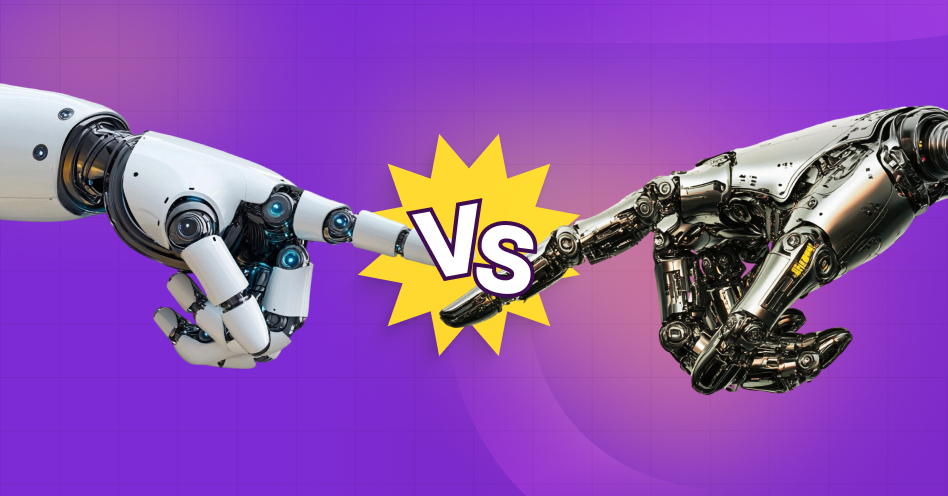

Cybersecurity has entered a new phase. Attackers are no longer limited by manual effort. With AI, they can move faster, test more attack paths, and create more convincing threats than anything we’ve dealt with before. And the gap between what they can do and what most organisations are prepared for? It’s wider than most business leaders realise.
This isn’t about fear. It’s about understanding a shift that’s already happening, and making sure your organisation isn’t caught off guard.
Cyberattacks Are Moving Faster
Not long ago, launching a targeted cyberattack took real time and effort. Research, writing, coordination, and testing. Now, AI compresses all of that. Attackers can scan for weaknesses, generate phishing content, write malicious code, and adapt their tactics without the same manual overhead that used to slow them down.
The main risk isn’t complexity. It’s speed and scale. An attacker using AI can run more attempts, across more targets, in less time. Businesses that haven’t updated their thinking around this are operating with a threat model that no longer reflects reality.
What Are Fully Automated Cyberattacks?
Let’s be precise about what this actually means, because the term gets misused.
Fully automated cyberattacks don’t always mean zero human involvement. What they mean is that more stages of the attack process can now run without someone manually operating each step. Reconnaissance, phishing, vulnerability scanning, malware variation, attack execution. These steps can be stitched together and partially or fully automated. That’s what makes them different.
Many attacks today are still AI-assisted rather than fully autonomous. But the direction is clear. Each year, more of the process can run without a human in the loop. Waiting to take that seriously is a risk.
How Attackers Are Using AI Right Now
- AI-generated phishing. Emails and messages that used to give themselves through poor grammar and generic phrasing are now personalised, contextually relevant, and convincing. AI can tailor content based on publicly available information about a target, their role, their company, and even their recent activity.
- Faster vulnerability discovery. AI helps attackers identify weak points and prioritise which attack paths are most likely to succeed. What used to take days can now happen in hours.
- Malware variation. Attackers can generate modified versions of malicious code to avoid signature-based detection. Traditional tools that look for known patterns struggle to keep up here.
- Deepfakes and impersonation. Voice cloning and video manipulation have moved from theoretical concern to real operational risk. They’ve already been used in financial fraud cases where employees believed they were speaking to executives and authorised large transfers.
- Automated attack chains. AI can connect different attack steps, reducing the time between gaining initial access and moving deeper into a system. That compression of time is exactly what makes detection and response so much harder.
Why Traditional Defenses Are Becoming Less Effective
Traditional tools aren’t worthless. A well-configured firewall, endpoint protection, and multi-factor authentication still matter. But many security tools were built around a threat model where attacks moved at human speed and followed recognisable patterns.
AI-assisted attacks don’t always match known patterns. They adapt. They vary. And security teams already dealing with hundreds of alerts a day are most likely to miss the ones that look slightly different from the usual noise.
The issue isn’t that traditional security has no value. The issue is that many traditional approaches weren’t built for threats that can adapt, scale, and move at machine speed. Alert fatigue is real. Security teams are stretched. Attack surfaces keep growing. And the window between first access and serious damage keeps shrinking.
Speed is the core problem. When a threat can escalate in minutes, a security approach built around manual investigation and periodic reviews simply can’t keep up.
Fighting AI with AI: The New Defense Model
The response to faster attacks is a faster defence. Not a replacement for security teams, but a way to give them better information and better tools to act on it.
- AI-powered threat detection. Monitors for unusual behaviour, suspicious access patterns, and early signs of compromise, continuously, across more data than any human team could review manually.
- Automated response support. Helps analysts prioritise alerts, investigate faster, and cut down on the manual triage that slows everything down when it matters most.
- Behaviour-based monitoring. A meaningful shift from signature-based detection. Instead of asking whether something matches a known threat, it asks whether something is normal for this user, this system, in this context. That means novel threats can still trigger a response.
- Vulnerability prioritisation. Helps teams focus on the weaknesses that create the highest business risk right now, based on how attackers are targeting them in the wild.
- Security awareness and simulation. Prepares employees for more realistic phishing attempts, impersonation scenarios, and deep-fake-based attacks that look and sound far more credible than what most training programmes currently cover.
AI defense isn’t about removing humans from the equation. It’s about helping them work faster, seeing more clearly, and responding with confidence when it counts.
What Business Leaders Should Do Now
This doesn’t have to be overwhelming. A few focused steps make a real difference.
Start with an honest assessment of your current cybersecurity maturity. Not a checkbox exercise, but a real look at where gaps exist. From there, review whether your existing tools can detect behaviour-based threats, not just known signatures.
Tighten identity and access management. It’s one of the most common entry points and still one of the most overlooked. Improve awareness training so your people know what AI-generated phishing, deepfakes, and impersonation look like today, not what they looked like two years ago.
Prioritise vulnerabilities based on business risk, not just severity scores. Build or update an incident response plan that accounts for faster-moving attacks. And work with a cybersecurity partner to identify gaps and build a practical roadmap, because understanding where your posture falls short often requires an outside perspective.
Faster Threats Need Smarter Defense
AI-powered attacks are not a future concern. They’re already shaping how cybercriminals operate today. Organisations don’t need to panic, but they do need to modernise.
By combining human expertise, strong security foundations, and AI-assisted defence, businesses can detect threats faster, respond with confidence, and stay better prepared for what comes next. The goal isn’t perfection. It’s closing the speed gap before an attacker exploits it.
As cyber threats become faster and more automated, we help organisations not only assess security gaps and strengthen their defenses, but also leverage AI strategically to enhance detection, automate response, and improve decision-making.
Speak with our cybersecurity experts to discover how AI can turn your security operations into a proactive, adaptive defense advantage, and identify where your organisation stands today and what to improve next