For years, modern data platforms were seen as a “nice to have” upgrade. Today, they are quickly becoming the default foundation for how enterprises run analytics, applications, and AI. As data volumes grow and AI moves from experiments to production, legacy stacks simply cannot keep up with the scale, speed, and flexibility the business now expects.
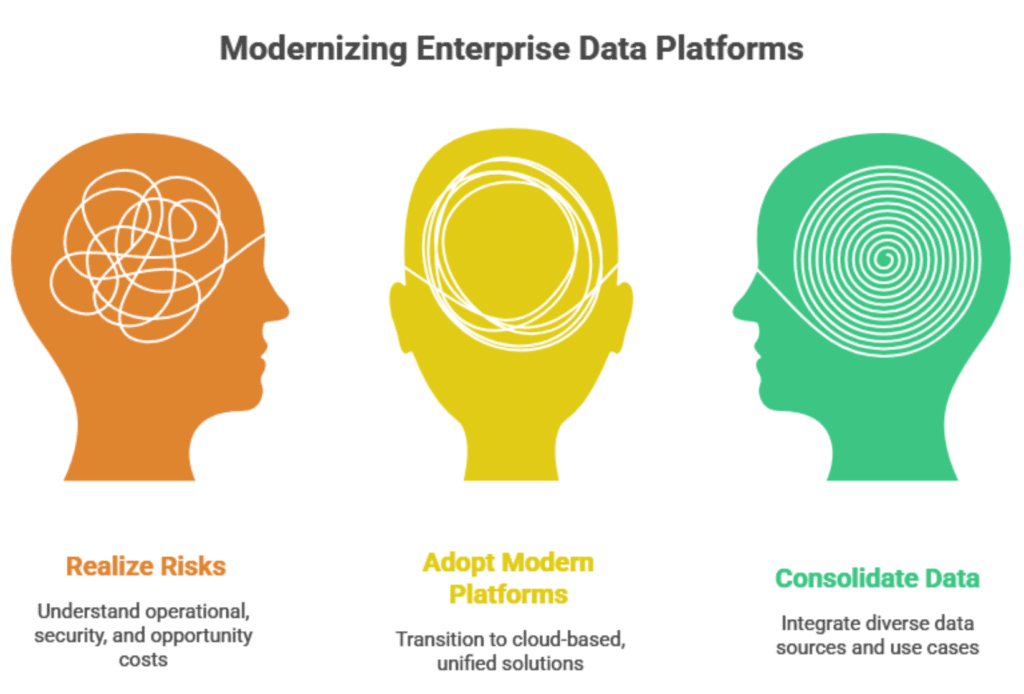
Leaders are realising that clinging to ageing platforms is no longer risk-free; it increases operational risk, security exposure, and opportunity cost over time. The direction of travel is clear: at the end of the journey, everything that matters – analytics, AI models, application, and operational data – will live on (or be powered by) a modern data platform.
This shift is already evident across large enterprises adopting modern data and AI platforms. A major financial institution successfully transitioned from a decades-old legacy environment to a cloud-based data and AI platform, consolidating dozens of data sources and hundreds of use cases across multiple business domains to enable faster, more data-driven decision making.
In another example, a large services organisation unified previously fragmented analytics platforms into a single enterprise data platform, significantly reducing processing time, manual reconciliation effort, and overall operating costs. Similarly, a regional healthcare provider modernised its entire data and analytics landscape by replacing traditional statistical tools with a Lakehouse architecture, simplifying its analytics stack, and improving agility.
Lakehouse architecture is a modern approach to building data warehousing systems, combining the data lake and data warehouse concepts into an open data management architecture.
What Is Driving the Shift?
Three forces are pushing organisations away from legacy technology and towards modern platforms:
- The AI and automation wave
Modern workloads depend on fast, trusted, integrated data across domains, which legacy silos and nightly batch jobs cannot provide. A modern data platform unifies real-time and historical data so AI models, analytics, and digital products can work from the same, governed foundation.
- Ever-changing business demands
New products, regulatory changes, and market shifts now arrive in months, not years. Cloud native, elastic architectures allow teams to spin up new data products and pipelines quickly, instead of waiting for hardware refreshes or lengthy change windows.
- Economic and operational pressure
Maintaining fragmented legacy estates is becoming more expensive and harder to staff, while pay-as-you-go cloud services and automation reduce both infrastructure and operational costs. Modern platforms let you redirect budget from “keeping the lights on” to innovation and growth.
Taken together, these trends make staying on legacy platforms the riskier, more expensive choice the longer you wait.
What Makes a Platform Truly “Modern”?
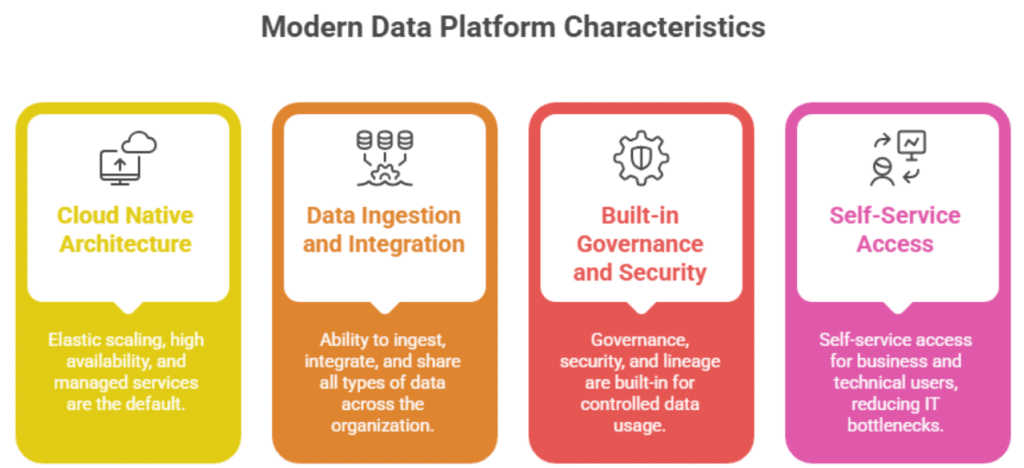
A genuinely modern data platform is more than a new database in the cloud. It has a few non-negotiable characteristics:
- Cloud native architecture with elastic scaling, high availability, and managed services as the default.
- The ability to ingest, integrate and share all types of data (batch, streaming, structured, semi structured) across the organisation.
- Built-in governance, security, and lineage so data can be widely used without losing control.
- Self-service access for business and technical users, reducing bottlenecks on central IT teams.
Many organisations implement this through a Lakehouse based platform, which combines the reliability of a warehouse with the flexibility of a data lake in one architecture. Whatever stack you choose, the end goal is the same: a single, trusted, future ready foundation for data and AI.
“All Roads Lead to the Platform” – But Not Overnight
Saying “in the end, everything will be on a modern data platform” does not mean you should migrate everything at once. The most successful strategies treat modernisation as a series of deliberate moves, guided by value and risk:
- Assess and prioritise
Catalogue systems, data domains, and workloads; identify where legacy constraints are creating the highest pain for the business. Define measurable goals such as cost reduction, faster analytics, or enabling specific AI use cases to keep the roadmap grounded. - Design the target platform and migration patterns
Choose your core cloud platform technologies, and security model, then define reference patterns (re-host, re-platform, re-factor, replace, or wrap via APIs). Use patterns like the “strangler” approach to slowly move data and functionality off legacy systems while they continue operating.
- Migrate by domain, not by system
Start with one domain (for example, customer orders, or assets) and move its data, analytics, and key workflows to the new platform. Prove value with concrete wins, then expand to adjacent domains in waves, gradually reducing the footprint of each legacy application.
Over time, more analytics, APIs, and applications will point to the modern data platform as their system of record, and legacy systems will either be simplified, wrapped, or decommissioned entirely.
Why Waiting Introduces a Bigger Risk
The reality is that every year spent delaying modernisation makes the eventual migration harder and more expensive. Data volumes grow, integrations multiply, and the people who understand the old systems retire or move on.
By contrast, organisations that start now, even with a narrow scope, begin compounding benefits immediately: lower infrastructure spend, faster insight cycles, and a platform ready for AI and new digital products. The destination is the same for everyone – a modern data platform at the heart of the business – but those who move first will be the ones defining the rules in their market when they get there.