Legacy systems are more than old technology – they contain years of business knowledge and the organisation’s most valuable data. The problem is that these systems were never designed for real-time analytics, AI, or today’s pace of change, so they quietly slow down decisions, innovation, and revenue growth.
A modern data platform changes that equation by turning legacy data into a governed, AI ready asset that business and IT can finally use together. Instead of a risky “rip and replace” program, we gain a safe, incremental path that preserves what works while unlocking invaluable new insights.
Why Legacy Systems Hold You Back
Most legacy estates share the same symptoms:
- Rising run and maintenance costs just to keep ageing hardware, licenses, and integrations alive.
- Slow, batch-based reporting that cannot support real-time decisions or personalised customer experiences.
- Data scattered across silos, making every new report or integration feel like a custom project.
This is not just an IT problem, these symptoms lead to missed cross sell opportunities, delayed launches, compliance risk, and an inability to exploit AI while competitors pull ahead.
What a Modern Data Platform Delivers
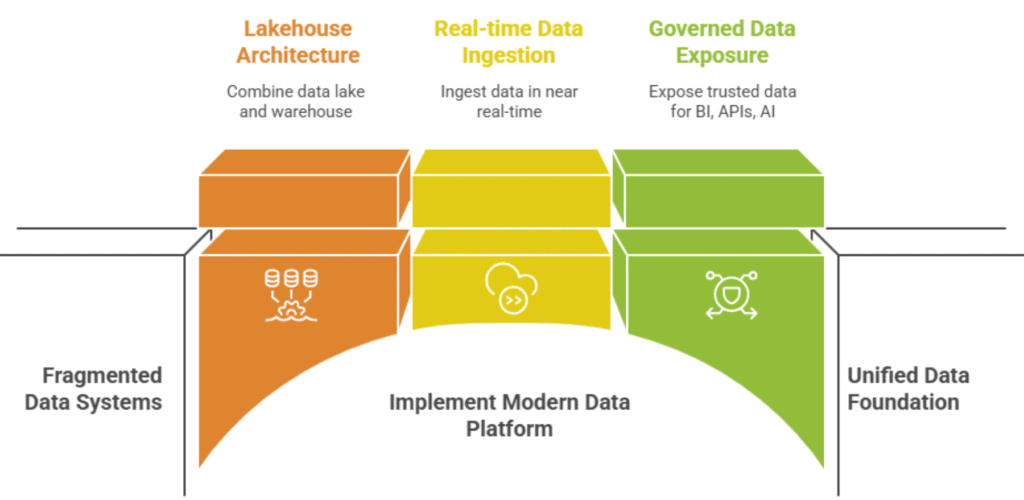
A modern data platform brings all your critical data into a single, scalable, cloud native foundation, often using a Lakehouse architecture as the core. Lakehouse architecture is a modern approach to building data warehousing systems, combining the data lake and data warehouse concepts into an open data management architecture. It connects seamlessly to legacy systems, ingests data in near real-time, and exposes trusted, governed data for BI, APIs, and AI workloads
From a business point of view, this means:
- Cost efficiency: Consolidate tools, reduce legacy infrastructure spend, and pay only for the capacity you use.
- Realtime insight: Move from monthly or weekly reports to near real-time visibility across operations, customers, and risk.
- AI readiness: Put high quality, well governed data in one place so data science and GenAI projects can move from POC to production.
In many organisations, this shifts alone releases budget from “keeping the lights on” to funding new digital products and automation.
Lakehouse: The Engine Behind the Platform
The data Lakehouse combines the flexibility of a data lake with the reliability and performance of a data warehouse, making it ideal for legacy modernisation. It supports structured and semi structured data, ACID (atomicity, consistency, isolation, durability) transactions, and high-performance SQL on open formats, so all teams can work from the same source of truth.
For your legacy estate, this means you can:
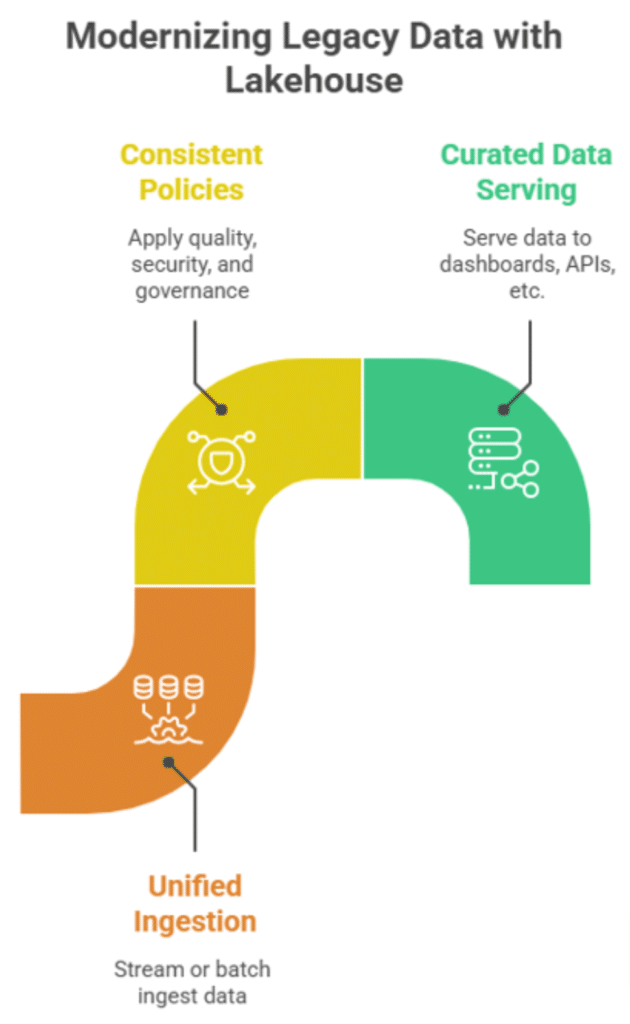
- Stream or batch ingest from mainframes, ERP, and line–of–business databases into one unified platform.
- Apply consistent quality, security, and governance policies instead of rebuilding them tool by tool.
- Serve the same curated data to dashboards, APIs, data products, and AI models without duplicating pipelines.
The result is a simpler, more predictable architecture that scales with data growth and new use cases.
A Low-Risk Journey, not a Big Bang Rewrite
Modernising legacy systems with a modern data platform should be evolutionary, not disruptive. The most successful organisations follow a value first, low risk path:
- Start with one high value use case – Pick a domain where legacy limitations are clearly hurting the business (for example, customer 360, fraud analytics, asset performance, or reporting automation).
Define concrete outcomes such as “reduce report preparation from days to hours” or “improve campaign targeting accuracy.”
- Stand up the platform and connect legacy – Deploy the modern data platform in the cloud, configure security and governance, and connect to key legacy systems with ingestion pipelines.Use this first use case to validate performance, data quality, and governance with real users.
- Showcase quick wins to the business – Deliver dashboards, self-service analytics or AI powered insights that were previously impossible or painfully slow.Quantify value in terms of faster decisions, reduced manual effort, or new revenue so stakeholders see the impact.
- Scale out, then retire legacy components – Onboard more domains and workloads to the platform, gradually decommissioning overlapping data marts, ETL jobs and legacy reports.Over time the modern data platform becomes the strategic backbone, with legacy systems either simplified, wrapped, or replaced where it now makes clear economic sense.
This approach reduces risk, avoids long projects where the process and decision-making are opaque to stakeholders, and builds executive confidence at every step.
Why Partner with Mitrais?
Technology alone does not unlock legacy value; the right approach and experience do. Many teams struggle not with tools, but with where to start, what to prioritise, and how to keep business and IT aligned through the journey.
Mitrais can help you:
- Build a pragmatic roadmap that aligns modern data platform capabilities with your top three business priorities.
- Design a Lakehouse based architecture tailored to your security, compliance, and performance requirements.
- Accelerate implementation using proven patterns, automation, and best practices from other modernisation programmes.
The outcome is a faster, safer path from legacy constraints to a modern, data driven business that is ready for AI and future growth.